

Build vs Buy AI Agents and RAG: What It Really Costs Over Time

October 29, 2026
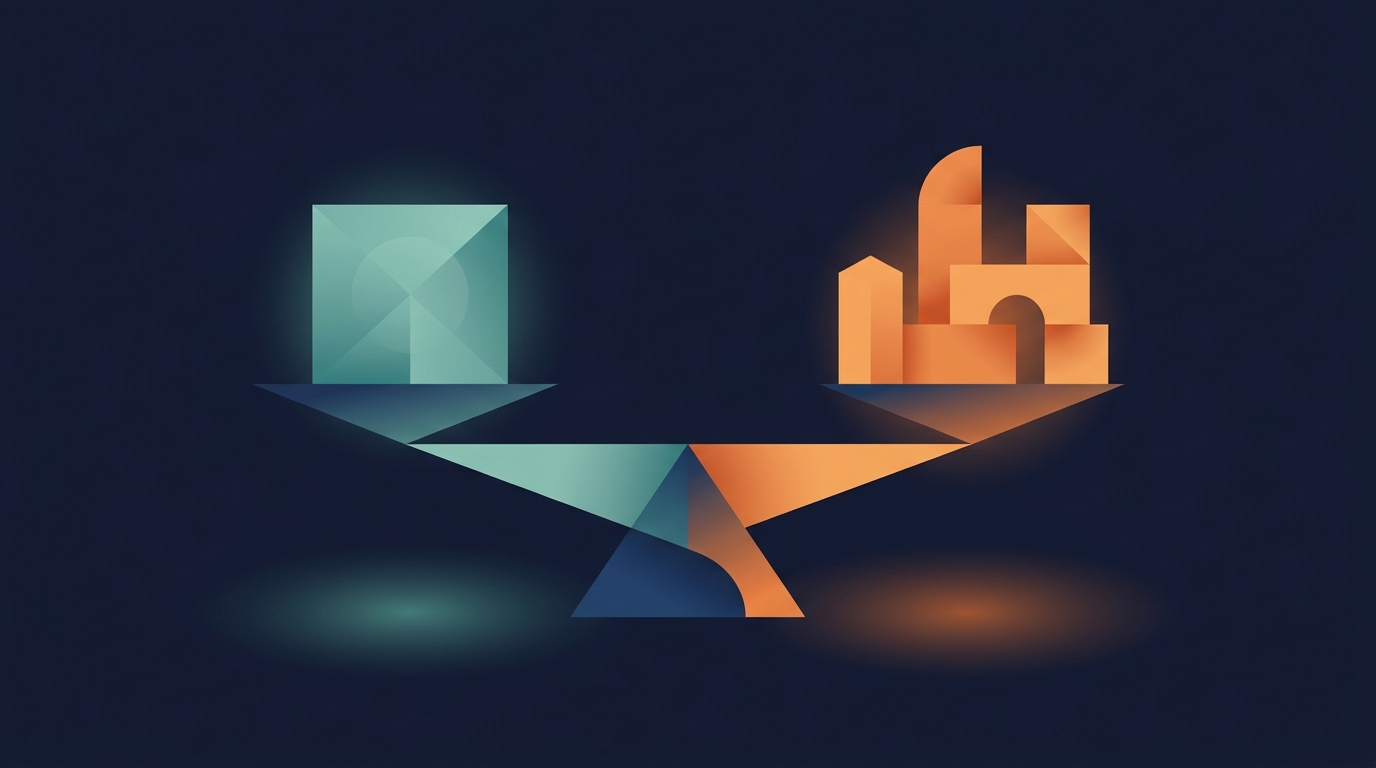
In the build vs buy AI agents decision, buy when the task is common, your data is generic and an off-the-shelf tool already connects to the systems you use. Build when the value depends on your proprietary data, deep integrations, fine-grained permissions or an audit trail that no packaged tool provides. Most companies end up with a hybrid: bought tools for general work, custom agents for the few workflows that set them apart. The real cost is not the first build or the first subscription. It is data preparation, integration, evaluation and upkeep over several years.
This article is for founders, COOs and CTOs who are weighing an AI agent or a retrieval-augmented generation (RAG) system and want to understand where the money actually goes before they commit.
What “build” and “buy” really mean for agents and RAG
The terms are blurrier than they sound. Nobody builds a large language model from scratch for a business workflow. “Build” usually means assembling a system around a hosted or private model: retrieval over your documents, connections to your tools, rules about who can see what, and tests that check the output.
“Buy” ranges from a general AI assistant your team logs into, to a vertical product made for one job such as support ticket triage or contract review, to an agent platform where you configure workflows without much code.
A RAG system answers questions by first finding relevant passages in your own content and then asking the model to answer using only those passages. An agent goes further: it takes actions, such as updating a CRM record, drafting a quote or filing a ticket. Agents usually need RAG underneath them, so the two decisions are linked. For a deeper look at how retrieval is designed, see our page on RAG and context layers.
When an off-the-shelf tool is enough
Buying is often the right first move. It is faster, the vendor carries the maintenance and you learn what your team actually needs before spending on custom work.
An off-the-shelf tool is usually enough when:
- The task is common. Meeting notes, email drafting, summarizing public research and general writing help are well served by existing products.
- Your data is not sensitive. If the content is public or low risk, the vendor’s data terms matter less.
- The tool already connects to your systems. If it has a working integration with your help desk, drive or CRM, you skip the hardest part of a custom build.
- Everyone can see the same information. Permissions are simple, or the tool respects your existing ones.
- Errors are cheap. A person reviews every output anyway, and a wrong answer costs a few minutes, not a lost customer or a compliance issue.
If all five are true, buy, measure for a quarter and revisit with real usage data.
When a custom build wins
Custom work earns its cost when the AI has to know things only your company knows, or do things only your systems can do.
- Proprietary data is the value. Your pricing history, engineering specs, case files or customer contracts are what make the answers useful. Generic tools either cannot reach this data or handle it poorly.
- Integrations go deep. The agent needs to read from your ERP, write to your CRM and check inventory in a warehouse system, often with business rules in between.
- Permissions are fine-grained. A regional manager should see only their region. A contractor should not see salary data. The AI must respect these rules on every query, not just at login.
- You need an audit trail. Regulated industries, and many enterprise customers, will ask what the AI did, which sources it used and who approved the action.
- Data must stay private. Some content cannot leave your environment, which may mean running parts of the system on private or on-premise models.
The cost drivers, line by line
AI project budgets often go wrong because people price the model and forget everything around it. The table below shows where cost comes from in a build and in a bought tool. Relative size depends heavily on your data and systems, so treat it as a map, not a quote.
| Cost driver | Custom build | Off-the-shelf tool | Typical relative size |
|---|---|---|---|
| Data preparation | Cleaning, deduplicating and structuring documents; setting up indexing and refresh jobs | Still needed if you upload your own content; usually lighter | Often the largest one-time cost for RAG |
| Integrations | Building and testing connections to each internal system, including error handling | Free if a connector exists; custom work or impossible if not | Grows with every system the agent touches |
| Permissions and security | Mapping access rules, enforcing them per query, security review | Depends on what the vendor supports | Moderate; high in regulated settings |
| Evaluation | Building test sets, scoring answers, regression checks before each release | Your own spot checks; limited control over changes | Moderate up front, ongoing after |
| Hosting and model usage | Pay per token or run private models on your own hardware | Per-seat or per-usage subscription | Scales with volume; can grow fast with agents |
| Maintenance | Model upgrades, prompt fixes, data drift, new edge cases | Handled by the vendor, on their schedule | Steady yearly cost that many teams underestimate |
| Change management | Training users, adjusting workflows | The same | Small in money, large in effect on adoption |
Two patterns stand out. First, agents cost more to run than chat tools, because a single task can involve many model calls as the agent plans, checks and retries. Second, evaluation is the line most often cut and most often regretted. Without it, nobody knows whether a model upgrade made the system better or worse.
The hybrid option
For most growing companies, the honest answer is “both.” Buy general tools for everyday productivity. Build a small number of custom agents where proprietary data, integrations or compliance make the difference.
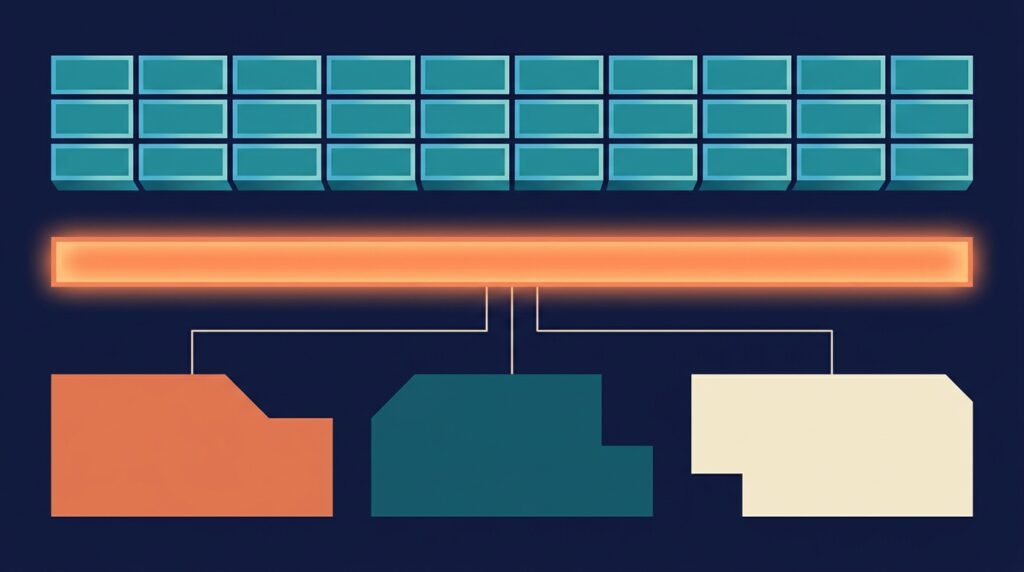
A well-designed hybrid usually has three layers:
- Bought tools for broad tasks such as writing, summarizing and research on public information.
- A shared context layer you own: your indexed documents, permission rules and logs. Both bought and custom tools can draw on it where the vendor allows.
- Custom agents for two or three high-value workflows, built on that context layer and using whichever model fits each task.
Owning the middle layer is the key. It keeps your data organized in one place, makes switching model providers easier and stops each new tool from creating another copy of your documents. Our enterprise agents work follows this pattern, with private AI used first for sensitive data.
Total cost of ownership over time
The first-year comparison almost always favors buying. A subscription starts small, while a build has a visible up-front cost. The picture changes over three years.
- Year one. Build costs are front-loaded: data preparation, integrations and evaluation. Bought tools are cheap to start, though seat costs add up as more teams join.
- Year two. Build costs drop to hosting, model usage and maintenance. Bought tool costs usually rise with seats and usage tiers, and gaps in the tool lead to workarounds and manual steps.
- Year three. A well-run custom system often costs less per task than it did at launch, because model prices tend to fall and the team has fixed the early problems. A bought tool’s price is set by the vendor.
Hidden costs sit on both sides. Builds risk a key engineer leaving or a system no one maintains. Bought tools carry lock-in, price increases and the cost of moving your data out later.
Example: a 60-person distributor answering quote requests
This is a hypothetical example. A 60-person industrial parts distributor receives quote requests by email. Each one needs a sales rep to check the catalog, look up customer-specific pricing in the ERP and confirm stock before replying. Reps spend a large part of their day on this.
The team first tries a general AI assistant. It drafts polite emails but cannot see pricing or stock, so reps still do the lookups.
They then build a narrow custom agent. It reads the incoming email, finds matching parts using retrieval over the catalog, pulls the customer’s price tier and stock levels from the ERP, and drafts a quote. A rep reviews and approves every quote before it is sent, and each draft shows which catalog pages and price rules it used.
The main costs were preparing catalog data, which had years of inconsistent part names, and building the ERP connection. The team measured average time per quote for a month before launch and tracked it after. The general assistant stayed in place for everything else. That is the hybrid in practice.
Frequently asked questions
Is RAG cheaper than fine-tuning?
For most business question-answering, yes. RAG uses your current documents without retraining a model, and updates are as simple as re-indexing. Fine-tuning helps with style, format or specialized language, and is often combined with RAG rather than replacing it.
Can we start with a bought tool and switch to custom later?
Yes, and it is often the smartest path. Keep your documents and permissions organized in a place you control, so the switch does not mean starting over. For common pitfalls when you do build, read about RAG implementation challenges and how to solve them.
How do we keep agent running costs under control?
Limit how many steps an agent can take per task, use smaller models for simple steps and cache repeated lookups. Track cost per completed task, not just total spend, so you can see whether usage growth is healthy.
What is the biggest risk in building?
Building something no one maintains. Plan for evaluation, monitoring and a named owner from day one. A custom agent without regular testing will drift as models, data and business rules change.
Do custom agents need human approval?
For any action that affects customers, money or records, yes, at least at first. Start with the agent drafting and a person approving, then reduce oversight only where measured accuracy supports it.
Your next step
List the three workflows where your team spends the most time, and mark which ones depend on your own data or systems. Those are your build candidates; the rest are likely buy. If you want help pricing the build candidates honestly, our custom AI development team can review them with you in a free two-hour consultation, including data readiness, integration effort and a realistic view of running costs.