
AI consulting vs AI development: which does your business need?

November 2, 2026

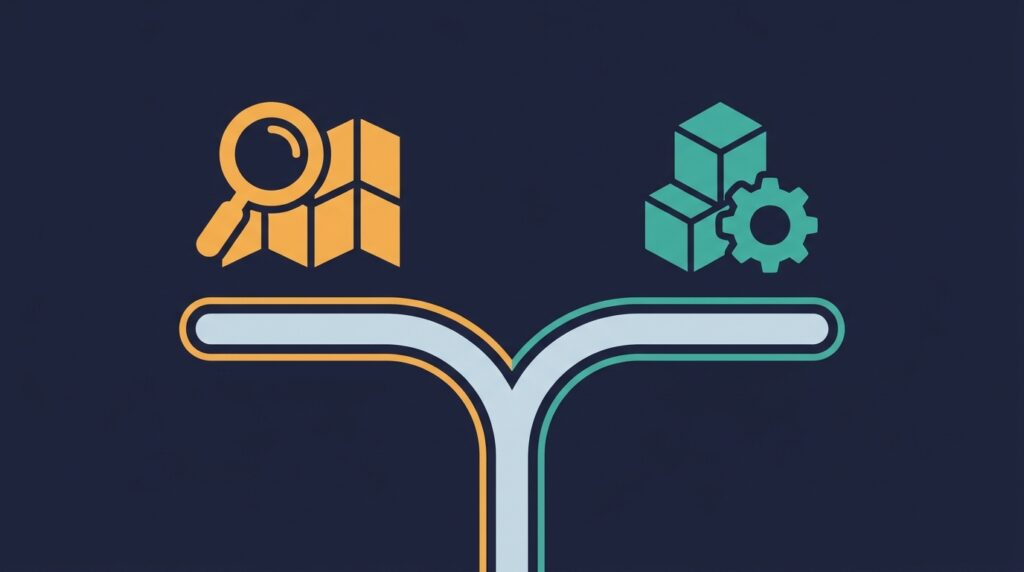
The short answer to AI consulting vs AI development: consulting decides what to build and whether it is worth building; development builds it and keeps it running. If you cannot yet name the workflow, the owner and the data behind an AI idea, you need consulting first. If you can name all three and the business case is agreed, you are ready to build.
This guide is for founders, CEOs, COOs and CTOs of startups and growing businesses who have a budget for AI, a list of ideas, and a nagging doubt about where to start. It explains what each type of work delivers, the signs that point one way or the other, and how the two fit together.
What AI consulting delivers
AI consulting is decision work. A good engagement ends with fewer, better ideas and a clear plan for the ones that survive.
Typical outputs include:
- A use-case shortlist: ideas ranked by business value, feasibility and risk, with the weak ones dropped and the reasons written down.
- A data readiness review: where the needed data lives, how clean it is, who owns it, and what has to change before AI can use it.
- A governance and privacy plan: which data can go to a frontier model, which must stay on private or on-premises AI, who approves AI output, and how decisions are logged.
- A business case: the baseline (how long the task takes today, what it costs, how often it goes wrong) and the target you will measure against.
- A roadmap: the order of work, the first pilot, and what “done” looks like at each stage.
What AI development delivers
AI development is build work. It turns a defined use case into software your team uses every day. The output is working code, integrations, and the operational plumbing that keeps AI reliable once real users arrive.
Typical outputs include:
- A working application, agent, or feature, connected to your existing systems (CRM, ERP, document stores, email).
- Retrieval over your own documents so answers cite their sources, plus prompt and model selection tuned to the task.
- Guardrails: human approval steps, access controls, logging and audit dashboards.
- Evaluation tests that check accuracy before each release, monitoring for cost, speed, and errors.
- Handover: documentation, training, and a support plan.
The gap between a demo and a dependable system is mostly this last set of items. Our earlier piece on the harness layer between AI demos and enterprise reality covers why that work takes longer than the model itself.
Signs you need AI consulting first
Starting to build too early is the most common way AI budgets get wasted. These signs suggest you should pause and do the thinking first.
The use case is still a theme, not a workflow
“Use AI in customer service” is a theme. “Draft first replies to refund emails, with an agent approving each one” is a workflow. If your ideas sound like the first sentence, a developer will have to guess at the scope, and guesses are expensive to undo.
You are not sure the data is ready
AI is only as useful as the information it can reach. Warning signs include key knowledge living in people’s heads or inboxes, the same customer stored three different ways across systems, or no one able to say who owns a dataset. Fixing this is often the real first project.
Governance questions have no owner
Can client contracts be sent to an external model? Who signs off on AI-written content before it reaches a customer? What happens when the AI is wrong? If nobody can answer these, legal or security will stop the project late, after the money is spent.
Leaders disagree on the goal
If the CEO wants revenue growth, the COO wants cost savings and the CTO wants to modernize the stack, a build will satisfy none of them. A short consulting phase forces one agreed target and a way to measure it.
Signs you are ready to build
You can skip straight to development, or keep the consulting phase very short, when these four things are true:
- A clear workflow. You can describe the task step by step, with its inputs, outputs and the decision points where a human steps in.
- A named owner. One person is accountable for the result, has time to test early versions, and can make calls without a committee.
- Accessible data. The documents or records the AI needs exist in a system you control, and you have permission to use them for this purpose.
- A measured baseline. You know roughly how long the task takes today and how often it goes wrong so you can prove the improvement.
If even one of these is missing, the build will stall at that point.
AI consulting vs AI development: side by side
| AI consulting | AI development | |
|---|---|---|
| Main question | What should we build, and is it worth it? | How do we build it so it works every day? |
| Main output | Shortlist, data review, governance plan, business case, roadmap | Working software, integrations, guardrails, monitoring |
| Who is involved | Leadership, process owners, IT, legal or compliance | Product owner, engineers, end users testing releases |
| Typical length | Weeks | Weeks for a pilot, months for a production rollout |
| Pricing shape | Often fixed-fee, defined scope | Usually sized by scope, integrations and team size |
| Main risk if skipped | Building the wrong thing well | A good plan that never ships |
| You are done when | One use case is agreed, with an owner, data and a target | Users rely on it and the target metric has moved |
How the two connect: roadmap, pilot, production
In practice, the choice is rarely either-or. Most successful AI programs move through three stages, and the weight shifts from consulting to development as they go.
- Roadmap (mostly consulting). Assess readiness, pick one high-value workflow, agree on the governance rules and measure the baseline. At IndaPoint this readiness assessment and roadmap typically takes two to four weeks.
- Pilot (mostly development). Build the smallest version that does the real job for a small group of users. Keep a human approving every output. Measure against the baseline.
- Production (development with ongoing advice). Harden security, add monitoring and audit trails, roll out to more users, and train them. Revisit the roadmap to choose the next workflow using what the pilot taught you.
Cost and time: what drives each
We will not quote market prices here, because they vary widely by country, scope and team. What we can describe is the shape of the spend.
Consulting costs are driven by how many use cases you want assessed, how many teams must be interviewed, and how messy the data picture is. Because the scope can be fixed up front, consulting is often sold as a fixed fee, which makes it the smaller and more predictable line item.
Development costs are driven by different things:
- Integrations: each system the AI must read from or write to adds work, and older systems add more.
- Data preparation: cleaning, labeling and structuring documents can take longer than building the AI feature.
- Privacy requirements: running models on private or on-premise infrastructure costs more to set up than calling a hosted model, but may be required for sensitive data.
- Accuracy bar: a tool that drafts for human review needs less testing than one that acts on its own.
- Running costs: model usage, hosting and monitoring continue after launch, so budget for them from day one.
The relative pattern is consistent: a consulting phase is a small fraction of a production build, and it most often pays for itself by cutting ideas that would have been expensive to build and hard to use.
Example: a 60-person distributor deciding where to start
This is a hypothetical example. A 60-person industrial parts distributor wants to “use AI.” The founder has three ideas: a sales chatbot, automated quotations and AI-written product descriptions.
A short consulting phase finds that the chatbot has no clear owner and would need product data that sits in spreadsheets on two laptops. Product descriptions are low value because the catalog rarely changes. Quotations, however, are a clear workflow: sales staff copy prices from the ERP into a template many times a week, errors are common, and the sales manager is keen to own the project.
The company measures how long a quotation takes today and how many go out with mistakes. It agrees that quotes stay inside its own systems and that a person approves every quote before it is sent. Only then does development start, with a pilot for three sales staff. Once the pilot beats the baseline, it rolls out to the full team, and the chatbot goes back on the roadmap behind a data cleanup project.
Frequently asked questions
Can one firm do both AI consulting and AI development?
Yes, and it can reduce handover losses, because the people who made the plan understand why each decision was made. The risk is a consultant who recommends building everything. Ask for the list of ideas they advised against, and why.
How long should an AI consulting phase take?
For a growing business looking at a handful of ideas, a few weeks is usually enough. If it runs for months without a single use case being agreed, the scope is too broad or the decision-makers are not in the room.
We already know what we want. Can we skip consulting?
If you pass the four readiness checks above (workflow, owner, data, baseline), yes. Many teams still benefit from a short governance and privacy review before the build, because those questions are cheaper to settle on paper than in code.
What should a consulting engagement hand over?
At minimum: a ranked use-case list, a data readiness view, governance rules, a measured baseline and a roadmap for the first pilot. If you cannot hand those documents to a development team and have them start work, the consulting is not finished.
Your next step
Write down your top three AI ideas and, for each one, the workflow, the owner, the data source and today’s baseline. Any gaps you find tell you where to start. If most of them are gaps, begin with AI consulting to build a prioritized roadmap. If one idea is fully defined, look at custom AI development for the pilot. Either way, you can book a free two-hour consultation to test your list with an experienced team before you commit budget.