

RAG vs fine-tuning for business documents: which to choose

November 19, 2026

For most business documents, start with retrieval-augmented generation (RAG). It keeps answers current, shows the source page for every claim and lets you update knowledge by adding a file, not by retraining a model. Choose fine-tuning when the problem is how the model writes or behaves, such as a fixed output format, house style or a narrow classification task, rather than what it knows. Many mature systems use both: RAG for facts, fine-tuning for form.
This guide is for founders, operations leaders and CTOs who want AI to answer questions from contracts, policies, manuals, case files or reports, and who are weighing the RAG vs fine-tuning decision before they commit budget.
What RAG does, in plain terms
RAG works like an open-book exam. When someone asks a question, the system first searches your documents for the most relevant passages, then hands those passages to a language model with an instruction: answer using only this material, and say where each point came from.
The model itself does not change. Your knowledge lives in a searchable index next to it. Add a new policy, and it is searchable within minutes. Delete an outdated contract, and it stops appearing in answers. Because the system knows which passage it used, it can show a citation down to the page.
The quality of a RAG system depends mostly on retrieval: how documents are split into chunks, how they are indexed and how well the search finds the right passage. When answers are wrong, the cause is usually that the right passage was never found, not that the model failed to read it.
What fine-tuning does, in plain terms
Fine-tuning is more like training an employee until habits become automatic. You take an existing model and continue training it on many examples of the input and the output you want. The model’s internal weights change, so the new behavior is built in.
Fine-tuning is good at teaching patterns: always produce this JSON structure, write in this tone, classify these documents into these 40 categories, use this domain vocabulary correctly. It is less reliable as a way to store facts. A fine-tuned model may recall a fact from training, but it cannot tell you which document it came from, and it will not know about anything written after training.
Fine-tuning also needs prepared data: usually hundreds to thousands of high-quality example pairs, reviewed by someone who knows what “correct” looks like. Preparing that data is often the bulk of the work.
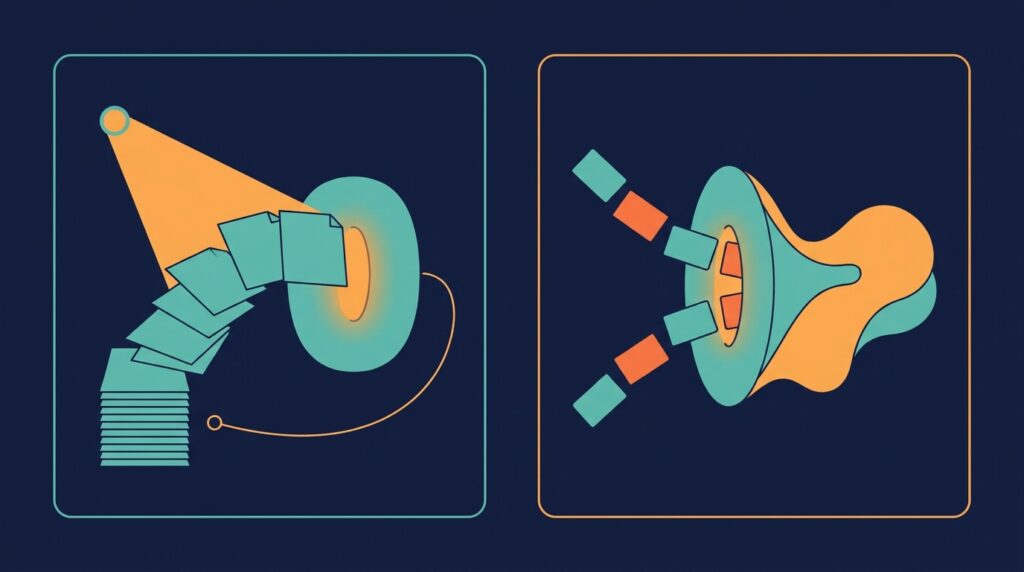
RAG vs fine-tuning: side-by-side comparison
The table compares the two approaches on the factors that matter most for business documents.
| Factor | RAG | Fine-tuning |
|---|---|---|
| Freshness | Updates as soon as a document is added or removed from the index | Frozen at training time; new facts need another training run |
| Citations | Can cite the exact document and page behind each answer | Cannot reliably say where an answer came from |
| Upfront cost | Lower: indexing, search tuning and an interface | Higher: example preparation, training runs and evaluation |
| Running cost | Higher per request, because retrieved passages add text to every prompt | Can be lower per request, especially with a smaller tuned model and short prompts |
| Data needed | The documents themselves, cleaned and well organized | Many labeled input and output examples |
| Privacy and access | Documents stay in your index; permissions can filter what each user sees | Data is absorbed into the model; per-user access control is not possible inside it |
| Maintenance | Keep the index in sync, monitor retrieval quality | Retrain when data, rules or base models change |
| Best at | Answering questions from a changing body of documents | Consistent format, style, tone and narrow classification |
The privacy row deserves attention. With RAG, if a junior employee should not see board minutes, the search simply does not return them for that user. Once information has been trained into a model, there is no reliable way to stop the model from revealing it to anyone who uses it.
When to choose RAG
RAG is the right default when the main goal is accurate answers from your own documents. Choose it when:
- Documents change often. Price lists, policies, product manuals and case files are updated weekly or daily.
- People need to verify answers. Legal, compliance, healthcare and finance teams must see the source before they act.
- Different users have different access. Answers must respect the same permissions as your document store.
- You want to start quickly. A focused RAG system on one document set can be built and tested without months of data labeling.
Our team covers retrieval design, chunking and access control in more depth on the RAG and context layers page. For common failure points, see our earlier post on RAG implementation challenges and solutions.
When to choose fine-tuning
Fine-tuning earns its cost when the gap is behavior, not knowledge. Choose it when:
- Output must follow a strict format. For example, every extracted invoice must produce the same fields in the same structure, every time.
- You need a consistent voice. Drafts must match a firm’s house style without a long instruction block in every prompt.
- The task is narrow and high volume. Sorting thousands of documents a day into fixed categories can run faster and cheaper on a small tuned model.
- Prompting has hit its limit. You have tried clear instructions and examples, measured the results and still fall short.
Before fine-tuning, ask whether better instructions or a few examples in the prompt would solve the problem. They often do, at a fraction of the effort. When they do not, the fine-tuning page explains how we prepare data and evaluate tuned models.
When to combine them
The two approaches solve different problems, so they combine well. A common pattern is to use RAG to fetch the facts and a fine-tuned model to present them in the required form.
- Retrieve. The system searches your documents and finds the relevant passages.
- Generate. A model tuned on your formats and terminology writes the answer from those passages only.
- Cite. Each statement links back to the source page.
- Check. Automated checks confirm every citation exists and supports the claim; a person approves anything high-risk.
Another useful combination is to fine-tune the retrieval side: training the search model on your domain vocabulary so it finds the right passage more often. This leaves the answering model untouched and keeps all the benefits of citations and freshness.
The rule of thumb is to build RAG first, measure where it falls short, and add fine-tuning only to fix a specific, measured gap.
Worked example: citations in legal research
Legal work is a clear case for retrieval, because an answer without a verifiable source is not usable. Two of IndaPoint’s legal products show what that looks like in practice.
PlasmaText is a research workspace where every AI answer cites its page. A lawyer uploads judgments, statutes or briefs, asks a question and gets an answer that points to the exact page it came from. It includes 23 report templates for common outputs. Reading and markup cost ₹0, forever, and the Pro plan is ₹499 per month. A design built on page-level citations is a retrieval design: the system must know which passage it used to cite it.
LexEdge is an AI workspace for legal drafting, research and citation checks, used by 240+ practices. It reports 6.2× faster case prep, 218 h saved per lawyer, per year, and 0% hallucinated citations. That last figure is the hardest to reach with fine-tuning alone. A model trained on case law may write convincing citations, but only a system that retrieves and checks the actual source can confirm each one is real.
Where fine-tuning fits in a product like this is form, not facts: drafting in the structure a court or client expects, while retrieval and citation checks keep the content grounded.
Frequently asked questions
Is RAG cheaper than fine-tuning?
Usually it is cheaper to build, because you do not need thousands of labeled examples or training runs. It can cost more per request, because retrieved passages add text to every prompt. For most document question-answering, RAG has the lower total cost in the first year.
Can fine-tuning stop a model from making things up?
Not on its own. Fine-tuning can make a model more confident in your domain, which can make wrong answers sound more convincing. Grounding answers in retrieved sources and checking citations is the more reliable way to reduce made-up content.
Can RAG run on private or on-premise infrastructure?
Yes. The index, the search and the model can all run inside your own cloud or data center, so documents never leave your network. This is a common setup for legal, healthcare and financial data.
How many documents do we need for RAG to be useful?
There is no minimum. RAG is useful as soon as people spend time searching a document set to answer repeat questions. What matters more is that the documents are readable, current and organized.
Should we fine-tune an open model or use a hosted one?
It depends on your privacy rules, volume and in-house skills. Tuning an open model gives you full control and can run privately; hosted tuning is simpler to operate. Decide after you have measured a clear gap that prompting and RAG cannot close.
Pick the right approach for your documents
Choose one document set and ten real questions your team asks about it every week. Test a simple RAG setup against those questions, measure accuracy and citation quality, and only then decide whether fine-tuning is needed. To scope that test with engineers who build both, see our custom AI development services or book the free two-hour consultation from that page.