

AI readiness checklist for growing businesses: 5 pillars to score

November 13, 2026
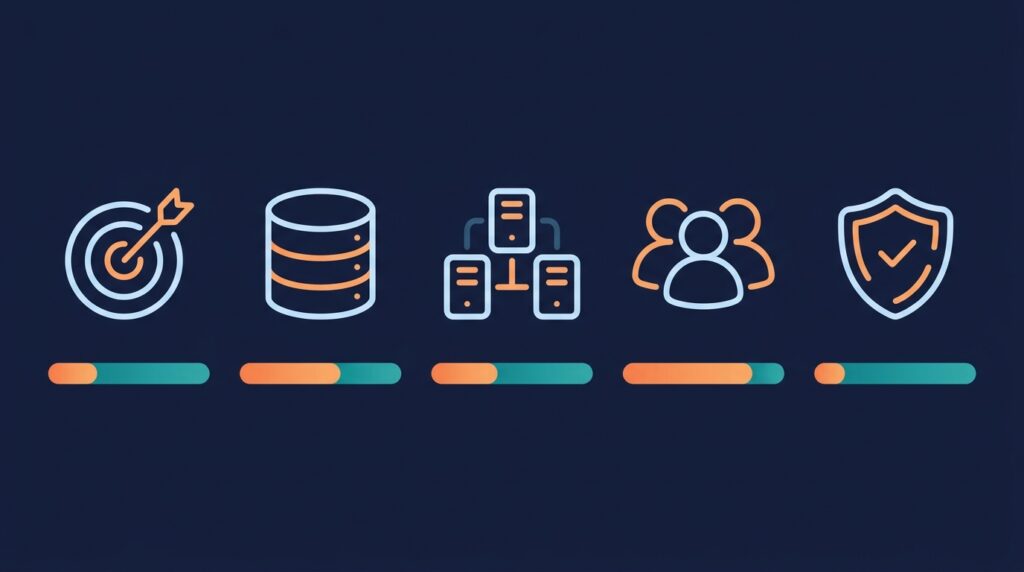
An AI readiness checklist tells you whether your business can get real value from AI now, or whether you need to fix a few foundations first. The checklist below covers five pillars: strategy, data, systems, people and governance. Score each one honestly, and the lowest score tells you exactly where to start.
It is written for founders, CEOs, COOs and CTOs of growing businesses, roughly 20 to 500 people, who are under pressure to “do something with AI” and want to spend that budget where it will pay back. You can work through it in an hour with your leadership team.
Why readiness matters more than the model
Most AI projects that disappoint do not fail because the model was weak. They fail because nobody agreed what success meant, the data was scattered, the tool could not reach the systems where work happens, staff did not trust it, or legal stopped it late.
Each of those is a readiness problem, and each is cheaper to spot before you build than after. A checklist turns a vague sense of “we are probably not ready” into a short list of fixable gaps.
The five pillars of the AI readiness checklist
Work through each pillar in turn. Every check is a yes, a partly or a no.
Pillar 1: Strategy
Strategy readiness means you know why you are using AI and how you will judge it.
- One named business goal. You can state the outcome in one sentence, such as “cut quotation turnaround” or “reduce support backlog,” not “become AI-first.”
- A shortlist of specific workflows. You have two to five candidate tasks, each described step by step, rather than broad themes.
- A measured baseline. For your top workflow, you know roughly how long it takes today, how often it happens and how often it goes wrong.
- An executive sponsor and a process owner. One leader backs the work, and one person who does or manages the task will own the result.
- A budget that includes running costs. You have planned for model usage, hosting and support after launch, not only the build.
Pillar 2: Data
AI can only work with what it can reach. Data readiness is about whether the information your chosen workflow needs is findable, usable and allowed.
- Known location. You can name the systems or folders that hold the documents and records the workflow uses.
- Clear ownership. Each important dataset has an owner who can approve its use.
- Reasonable quality. Key records are mostly complete and consistent; the same customer or product is not stored in conflicting ways across systems.
- Classified sensitivity. You know which data is personal, confidential or regulated, and therefore which data must stay on private or on-premise AI.
- Permission to use it. Contracts and privacy notices allow the data to be processed for this purpose.
Pillar 3: Systems
An AI tool that sits outside the systems where work happens becomes one more tab nobody opens. Systems readiness checks whether AI can plug into your existing stack.
- Access to core systems. Your CRM, ERP, help desk or document store offers an API or export that a new tool can use.
- Single sign-on and access control. You can control who sees what, so AI answers respect the same permissions as your staff.
- A place to run it. You have, or can set up, the cloud or on-premise environment the solution needs, including private hosting for sensitive data.
- Logging and monitoring. You can record what the AI was asked, what it answered and what it cost.
Pillar 4: People
The people pillar is often the deciding one. A good tool used by a skeptical, untrained team will underperform an average tool used by a team that understands it.
- Basic AI literacy. The people affected know what current AI does well, where it makes mistakes and why they must check its output.
- Time to test. The process owner and a few users have protected hours to try early versions and give feedback.
- Internal champions. At least one person per team is keen to experiment and can help colleagues.
- Clear messaging on jobs. Leadership has explained how AI will change roles, so staff are not quietly working against it.
- Technical capacity. You have engineers, in-house or through a partner, who can maintain the solution after launch.
Hands-on training closes this gap fastest. Cohort-based corporate AI training, where each person builds working automations for their own job, tends to turn skeptics into champions faster than slide decks do.
Pillar 5: Governance
Governance readiness means you have rules for safe use before the first real customer or employee data goes in.
- An AI use policy. Staff know which tools are approved and what data they may and may not paste into them.
- Human approval points. You have decided where a person must review AI output before it reaches a customer or changes a record.
- Source citations. For answers based on your documents, the AI shows where each answer came from, so reviewers can check it.
- An audit trail. Requests, outputs and approvals are logged and can be reviewed later.
- Vendor terms checked. Any frontier model you use is under an enterprise agreement that does not train on your data.
The AI readiness checklist at a glance
| Pillar | Key question | Ready looks like | Common gap |
|---|---|---|---|
| Strategy | Do we know why, and how we will measure it? | One goal, a specific workflow, a baseline, an owner | A list of themes with no baseline |
| Data | Can AI reach the right information, safely? | Known location, owner, quality and sensitivity | Knowledge stuck in inboxes and spreadsheets |
| Systems | Can AI plug into where work happens? | APIs, access control, hosting and logging in place | Older systems with no way in |
| People | Will the team use and maintain it? | Trained users, champions, protected test time | No time set aside to test |
| Governance | Can we use it safely and prove it? | Policy, approvals, citations, audit trail | No rule on what data goes to which tool |
How to score yourself
Keep the scoring simple so the conversation stays on the gaps, not the math.
- Score each check 0, 1 or 2. 0 means not in place, 1 means partly in place or informal, 2 means in place and written down.
- Turn each pillar into a percentage. Add the scores and divide by the maximum possible for that pillar (2 times the number of checks).
- Look at the lowest pillar, not the average. AI projects tend to fail at their weakest point. A strong strategy cannot make up for data nobody can reach.
- Score as a group. Ask the CEO, the CTO and a process owner to score separately, then compare. Big differences are a finding in themselves.
As a rough guide, a pillar at 75% or above is ready for a pilot, 40% to 75% needs targeted fixes that can run alongside a small pilot, and below 40% should be fixed before you build. If you would rather get a structured view in a few minutes, the free AI Readiness Score takes about three minutes and gives you a score and next steps.
What to do with low scores
A low score is useful information, not a verdict. Each pillar has a typical first fix.
- Low strategy: run a half-day workshop to pick one workflow, name its owner and measure today’s baseline. Drop the rest for now.
- Low data: start with the data for that one workflow only. Consolidate it, assign an owner and classify its sensitivity. Do not attempt a company-wide data project first.
- Low systems: check whether your core tools offer APIs or exports. If an older system has none, pick a first workflow that does not depend on it.
- Low people: give a small group hands-on training and protected time to test. Address job concerns openly and early.
- Low governance: write a one-page AI use policy and decide your human approval points. You can do this in days, and it unblocks everything else.
The common thread is narrowing scope. You do not need to be ready everywhere. You need to be ready for one workflow.
Example: a 120-person accounting services firm
This is a hypothetical example. A 120-person firm wants AI to help prepare client reports. The partners score the checklist together.
Strategy scores well: the goal is faster report preparation, the reporting manager will own it, and they know a typical report takes most of a day. Systems are fair, since the practice software has an export. People score low, because staff have only used public chatbots informally. Governance scores lowest: there is no policy, and some staff have already pasted client figures into free tools.
The firm fixes governance first, with a short use policy and a rule that client data only goes to approved, private tools. It trains a small group of report preparers in parallel. Within weeks both pillars move into the “targeted fixes” band, and a pilot on one report type can start with a reviewer approving every draft.
Frequently asked questions
How often should we repeat the AI readiness checklist?
Repeat it before each new AI initiative and at least twice a year. Readiness changes as you hire, change systems or adopt new tools, and a pillar that was strong last year can slip.
Do we need perfect data before starting with AI?
No. You need good enough data for the one workflow you are starting with. Trying to clean all company data first is a common way to delay AI for a year without any return.
Who should own AI readiness in a growing business?
One executive sponsor, often the COO or CTO, should own the overall picture. Each workflow then needs its own process owner who knows the work in detail.
Can a small company be AI-ready?
Yes, and often faster than a large one. Fewer systems and shorter decision chains make it easier to pass the checks. The same five pillars apply, with lighter documentation.
What is the difference between a readiness checklist and a readiness assessment?
A checklist is a self-review you can do in an hour. A full assessment goes deeper, with interviews, a data review and a roadmap, and at IndaPoint typically takes two to four weeks.
Your next step
Book an hour with your leadership team this week, score the five pillars together and write down the lowest one. That is your starting point. If you want an experienced team to turn the results into a prioritized plan, our AI consulting and readiness assessment starts with a free two-hour consultation. For further reading on why skipping this step gets expensive, see why AI costs rise when teams use AI without a strategy.